


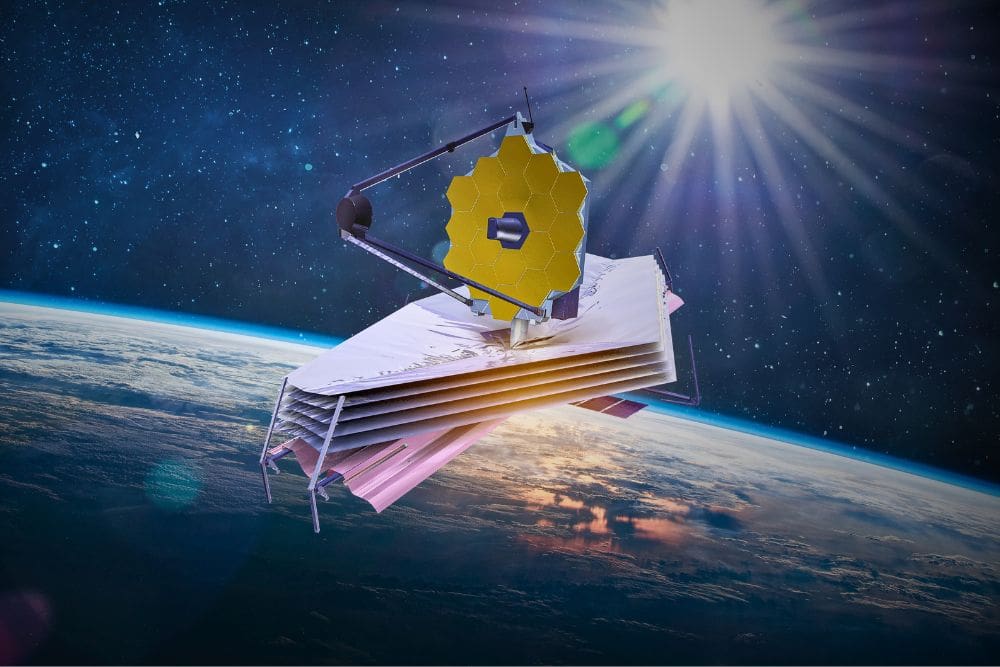
Laser Tracker Precision in Space Telescope Mounting.
Laser Tracker – Key to Precision in Mounting Space Telescopes
Precision plays a key role in the space industry, where every fraction of a millimeter matters. The construction of the James Webb Space Telescope (JWST) – the most advanced space telescope in history – required state-of-the-art technology. One of the key tools that enabled the success of this endeavor was the Laser Tracker, used to accurately measure and assemble the telescope’s mirrored segments.
Precise installation using a robotic arm
In a huge clean-room (aka clean-room) at NASA’s Goddard Space Flight Center in Maryland, a team of engineers installed 18 segments of the telescope’s primary mirror, which, joined together, will form the largest space mirror in history. Because of the unique requirements for precise alignment of the segments – to within fractions of a millimeter – the team used a robotic arm called the Primary Mirror Alignment and Integration Fixture.
Each segment of the mirror was made of beryllium to survive the extreme low temperatures of space, and a thin coating of gold provides infrared light reflection. In order for these components to work as a single unit, they had to be arranged with extreme precision.
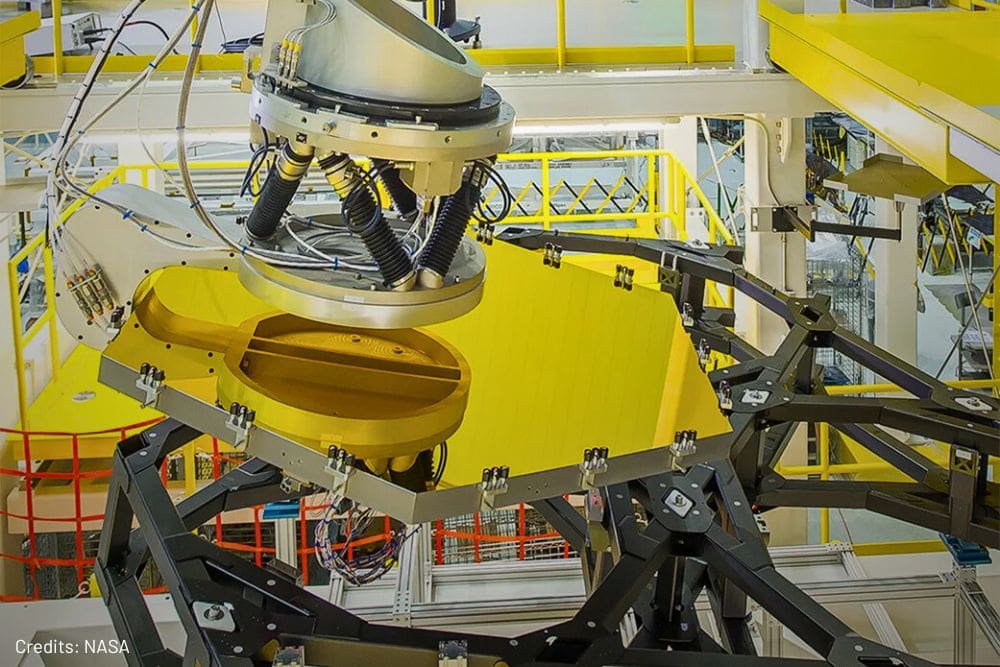
Laser Tracker – an essential tool for perfection
During the installation of the mirror, a Laser Tracker was used to achieve the required accuracy. This device works similarly to surveying equipment, using a laser beam to precisely measure distances. The device checked the position of reference points placed on the telescope elements, thus providing data on the location of the segments in XYZ (three-dimensional coordinate system) space.
This allowed engineers to relocate and install each mirror segment with precision comparable to the thickness of a sheet of paper. Laser Tracker allows to control the accuracy during the assembly of the components, and would have been impossible without such an application of such advanced measurement techniques.
Procedure:
- Reference points – The telescope’s structure and mirror segments were equipped with spherically mounted retro-reflectors (SMRs), which allowed the laser to determine the precise position of the elements.
- Installation process – Engineers operated the robotic arm while taking measurements with a Laser Tracker to make sure the segments were properly aligned before screwing and gluing them to the structure.
- Positioning – Based on the laser data, engineers observed and corrected the components’ deviations from the set nominal values (XYZ) in a three-dimensional coordinate system. The corrections enabled perfect alignment of each segment.
James Webb telescope – a new era in space exploration
The James Webb Space Telescope (JWST), the scientific successor to the Hubble Telescope, has become the most powerful space telescope that has opened up new possibilities for studying the universe. Thanks to it, scientists can study the origins of the universe, the formation of galaxies and planets. You can learn more at NASA‘s official website.
Why is Laser Tracker the future in the space industry?
The use of the Laser Tracker in the construction of the JWST shows that modern measurement technology is becoming a cornerstone of the space industry. Precise assembly, time savings and the ability to integrate with other systems, such as a robotic arm, make Laser Tracker an indispensable tool for the most complex engineering projects.
In an era of space exploration, where the margin of error is fractions of a millimeter, technologies such as Laser Tracker are becoming crucial if the dream of exploring deep space is to become a reality.