


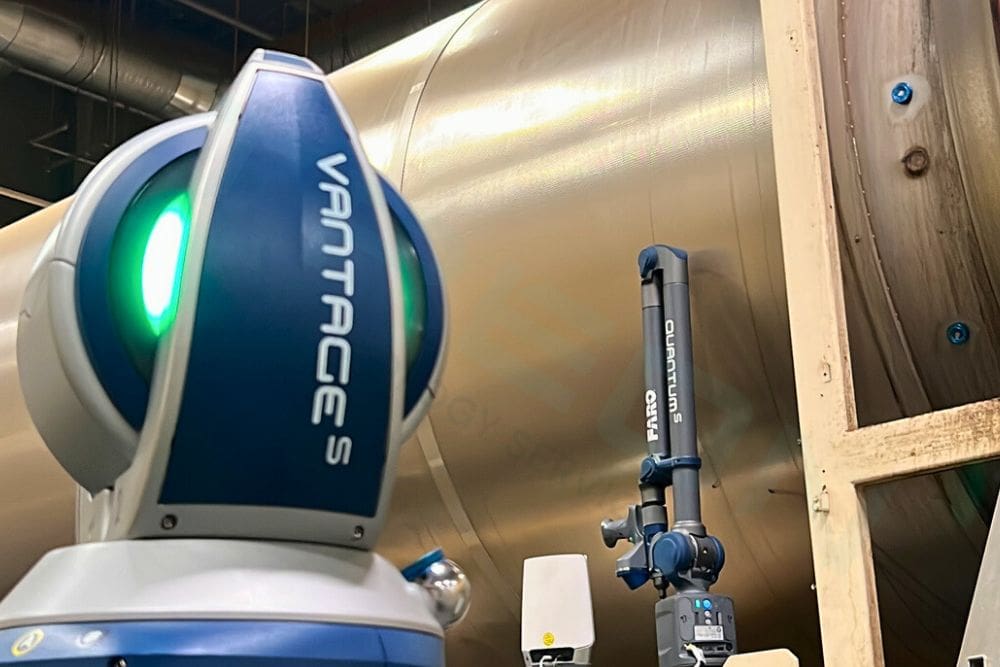
Measuring the raceway of a tobacco conditioning cylinder
Tobacco conditioning is a process that prepares the raw material for further technological processing. In industrial plants, it is carried out using special cylinders that ensure appropriate temperature and humidity conditions and stable mechanical operation.
In this type of machine, the geometric condition of the cylinder raceway is crucial. Even local damage can lead to malfunctioning of the entire system, increased vibration and a threat to operational safety.
In one of our recent projects, we measured the cylinder raceway of a direct tobacco conditioning machine after a malfunction.
Scope of the problem – deformation of the treadmill after failure
As a result of the failure, the side of the cylinder raceway became deformed.
The resulting damage caused:
- Lack of stable cylinder operation,
- The risk of further degradation of mating components,
- The inability to clearly assess the extent of the repair without taking measurements.
The client needed precise data on:
- maximum depths of damage,
- The distribution of deformations along the perimeter of the treadmill,
- The impact of deviations on the continued operation of the device.
It was crucial to perform the geometry inspection in a way that allowed a technical decision to be made: reconditioning or replacing the component.
 3D measurement technology used
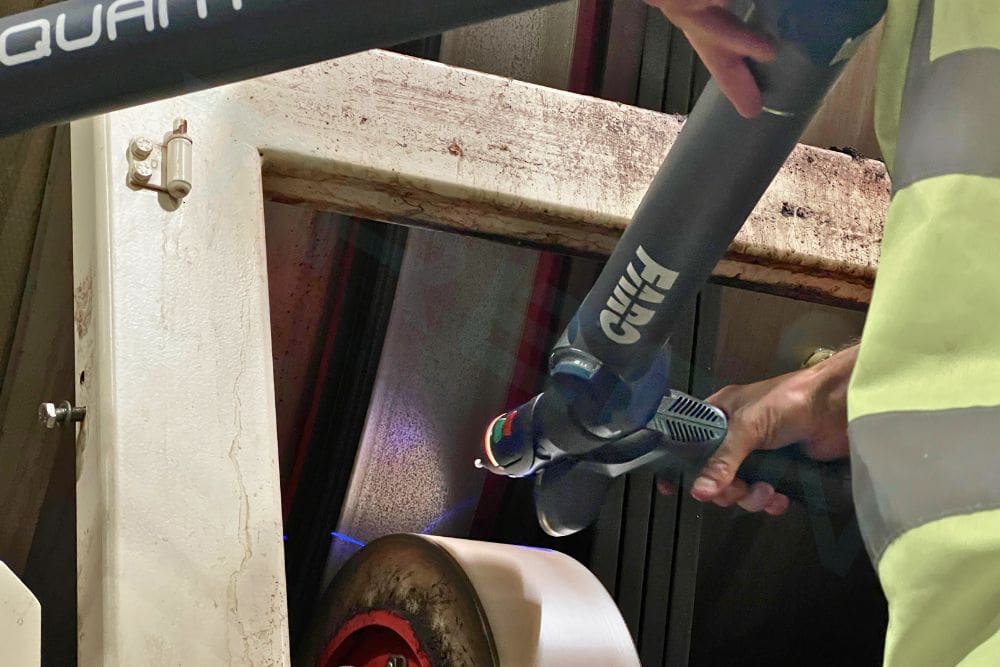 3D measurement technology used
In order to obtain reliable and comparable results, we used three independent measurement systems:
- Laser Tracker FARO Vantage S – for precise geometric positioning in space,
- FARO Quantum S measuring arm – for point measurements and verification of selected cross sections,
- FARO LLP handheld scanner connected to the arm – for acquiring a dense point cloud and analyzing surface shape.
We measured the cylinder raceway in two different ways to allow confrontation of the results and eliminate possible systematic errors. This approach allows us to increase the reliability of the data especially when analyzing shape deviations and damage depth.
Deviation analysis and shape measurements
Based on the collected data, it was conducted:
- Analysis of the shape of the raceway (cylindricity),
- Determination of maximum and local deviations,
- Determination of the depth of deformation,
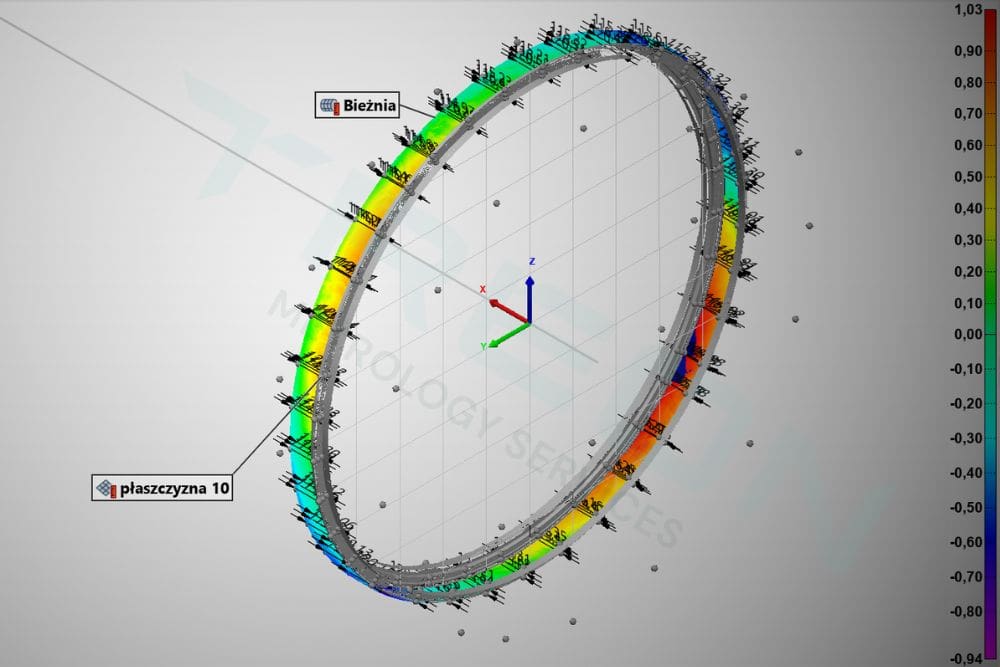
The use of 3D scanning made it possible to accurately map the surface and inspect the geometry over the full range of the perimeter, rather than just at the measurement points.
Preparation of a technical report
 Preparation of a technical report
Once the analyses were completed, we prepared a comprehensive PDF report including:
- visualizations of deviation maps,
- A summary of the maximum depths of damage,
- control sections,
- Technical conclusions on the condition of the treadmill.
The documentation allowed the client to clearly assess the condition of the component and estimate the scope of repair work.
Effect of implementation
After receiving the report on the measurement work, the client obtained:
- accurate data on the geometry of the cylinder raceway,
- information on maximum deformations,
- The basis for deciding how to repair the device.
Precise 3D measurements and control of shape deviations made it possible to reduce the risk of a wrong overhaul decision and minimize machine downtime.
When cylindrical components, raceways, rollers or rotating surfaces fail, performing geometry measurement and shape analysis allows you to move from conjecture to data-driven decisions.
If you are facing similar tasks in your company, call us for a ready-made solution. Please visit our contact page .