


The role of Laser Trackers in the construction of the LHC particle gas pedal
What is the LHC?
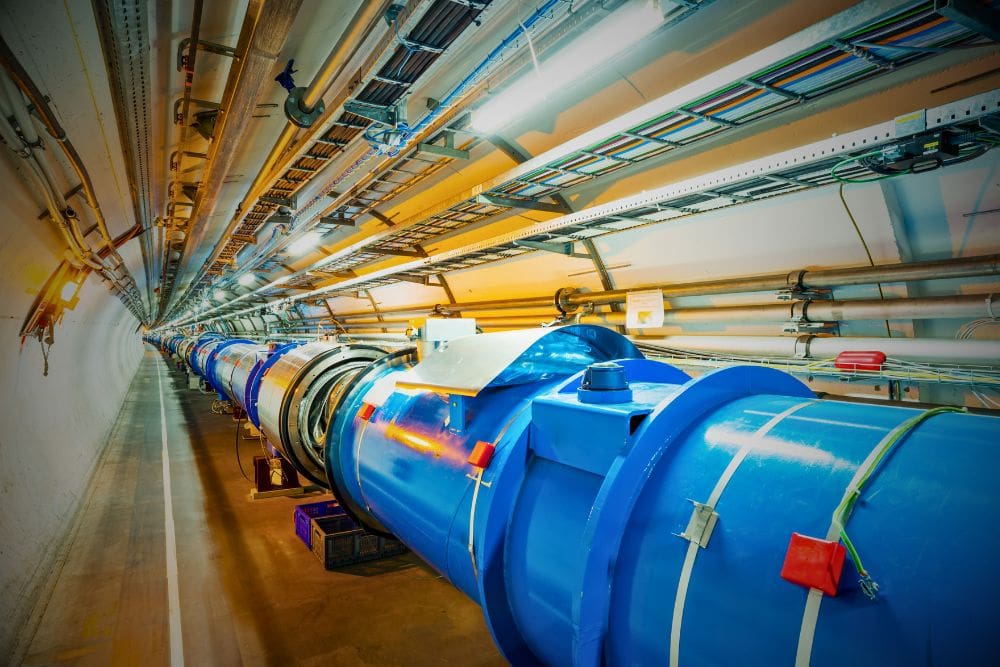
TheLarge HadronCollider (LHC) is the largest and most advanced particle gas pedal in the world, built by the European Organization for Nuclear Research (CERN). It is located in a 27-kilometer-long underground tunnel running under the border of France and Switzerland, near Geneva. Its main purpose is to study the basic components of matter and the principles that govern the Universe.
The LHC accelerates beams of protons or ions to speeds close to the speed of light and collides them with each other at four main detection points. These collisions produce new elementary particles that help scientists study the nature of matter and fundamental forces. One of the LHC’s greatest achievements was the confirmation of the existence of the Higgs boson in 2012 – the particle responsible for giving mass to other elementary particles.
How does the LHC work?
- Particle acceleration – Protons are initially obtained from hydrogen atoms and pre-accelerated in smaller gas pedals (Linac, Booster, PS, SPS) before they enter the main ring of the LHC.
- Beams in the tunnel – Two counter-rotating beams of protons are held and guided by powerful superconducting magnets placed cooled to a temperature of just 1.9 degrees above absolute zero (-271.25°C).
- Particle collisions – Beams are focused and directed to detection points, where they collide. The energy of these collisions reaches 13 teraelectron volts (TeV).
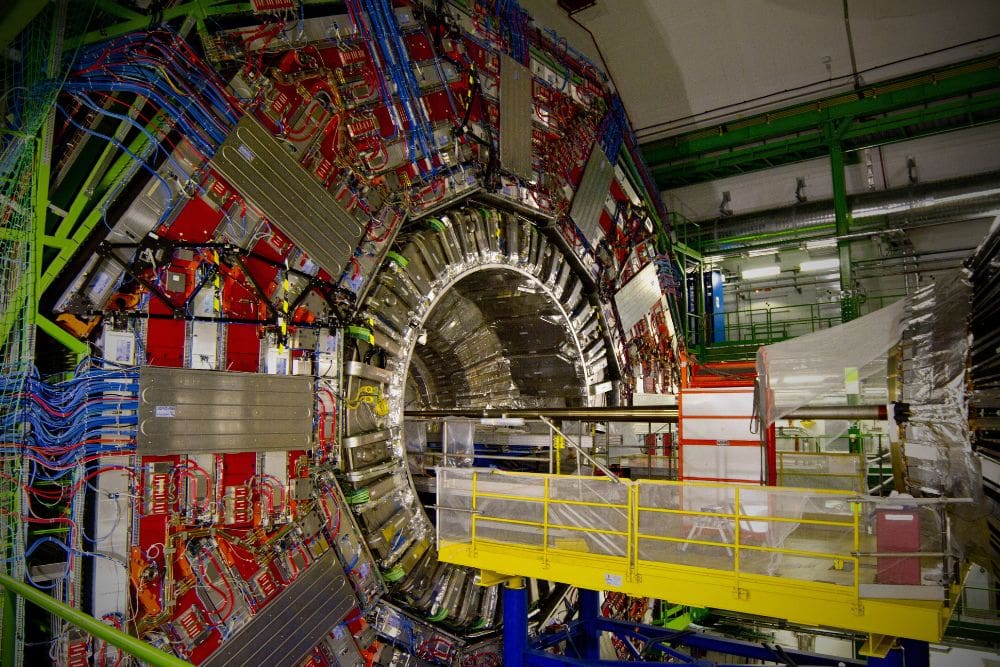
- Detection and analysis – The resulting particles are analyzed by giant detectors (ATLAS, CMS, ALICE, LHCb) that collect data to help study the composition of the Universe.
The cost of construction? 🙂
- CHF 4.6 billion (Swiss francs) of the total cost of the gas pedal
- CHF 1.1 billion of CERN’s total share of the experiment
- CHF 0.26 billion total share of data processing
The role of Laser Tracker measurements in the construction and assembly of LHC components
Precise installation of the LHC’s components was crucial to the proper operation of the gas pedal. Even minimal deviations in magnet positioning could affect particle trajectory and the quality of experiments. During the construction and operation of the Large Hadron Collider (LHC) at CERN, precise 3D measurements played a key role in ensuring the proper assembly and operation of the gas pedal. One of the most important tools used for this purpose was laser trackers, which enabled accurate measurement and control of the geometry of LHC components.
Principle of laser trackers and application to the LHC project
Laser trackers are advanced measuring devices that emit a laser beam that tracks the position of the reflector(SMR), which allows precise determination of the 3D coordinates of the measured points. This enables measurement accuracy of as much as 0.02 mm, which is crucial when working with large and complex structures such as the LHC.
These devices were widely used in various stages of LHC construction and operation. They were used to check the geometry during the fabrication of the magnets, allowing early detection and correction of any deviations from the design. In addition, during the installation of the magnets in the gas pedal tunnel, the laser trackers enabled precise positioning of these components, which was crucial for the proper operation of the entire system.
Integration with other measurement technologies
To increase measurement efficiency and accuracy, laser trackers were integrated with other measurement technologies, such as photogrammetry. This allowed for more comprehensive data on the geometry and position of LHC components, contributing to better quality control and assembly precision.
Summary
The use of laser trackers in the LHC project played a key role in ensuring the precise installation and operation of the gas pedal. They made it possible to achieve high measurement accuracy, which had a direct impact on the success of the entire project and enabled scientists to conduct research at the highest level.
Laser Tracker applications included:
- Accurate magnet positioning – The LHC contains more than 1,200 large dipole magnets, each of which had to be precisely positioned to within a fraction of a millimeter.
- Inspection of the tunnel geometry – Measurement of the tunnel and support structure enabled perfect matching of components.
- Verification of correct installation – After the components were installed, laser trackers were used to verify compliance with the design.
The LHC is a groundbreaking scientific project that is revolutionizing our understanding of the Universe. A key component of its construction was ultra-precise 3D measurements made with Laser Tracker technology. They made it possible to achieve unprecedented installation accuracy, which had a direct impact on the success of experiments conducted at CERN.
You can find more interesting facts here: LINK