


Digitization of Components: Precision 3D Scanning
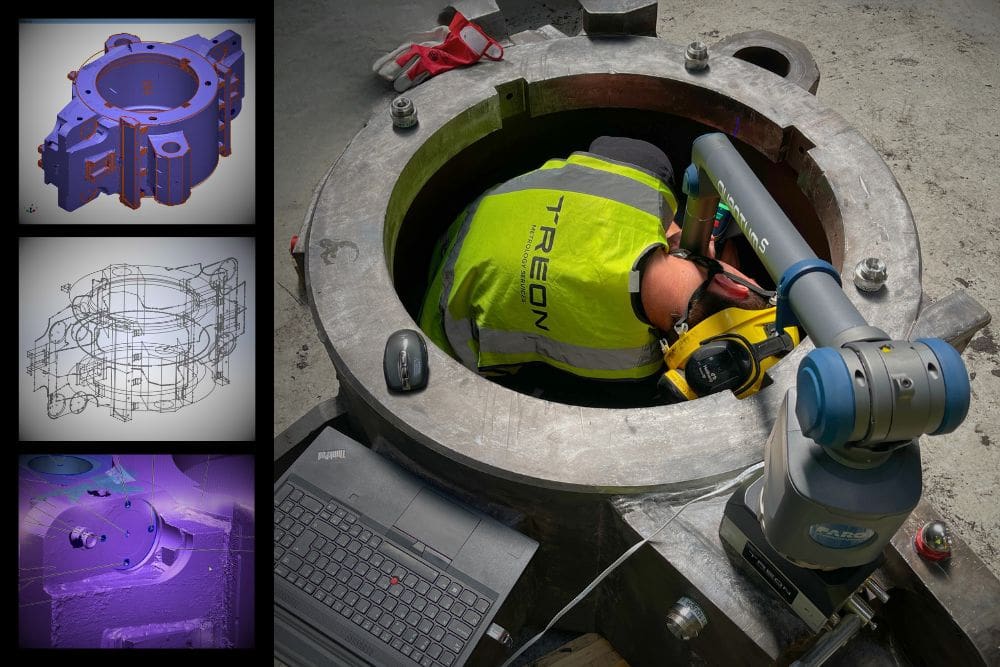
In the age of modern technology, 3D scanning of machine components is becoming a standard in the engineering process, enabling accurate representation of actual dimensions and their analysis. Here’s how we completed a comprehensive scanning and analysis project of twelve aluminum forming press components. From scanning to analysis to transferring the finished files to the customer.
Scanned items
The scope of the order included scanning 12 key elements of the press.
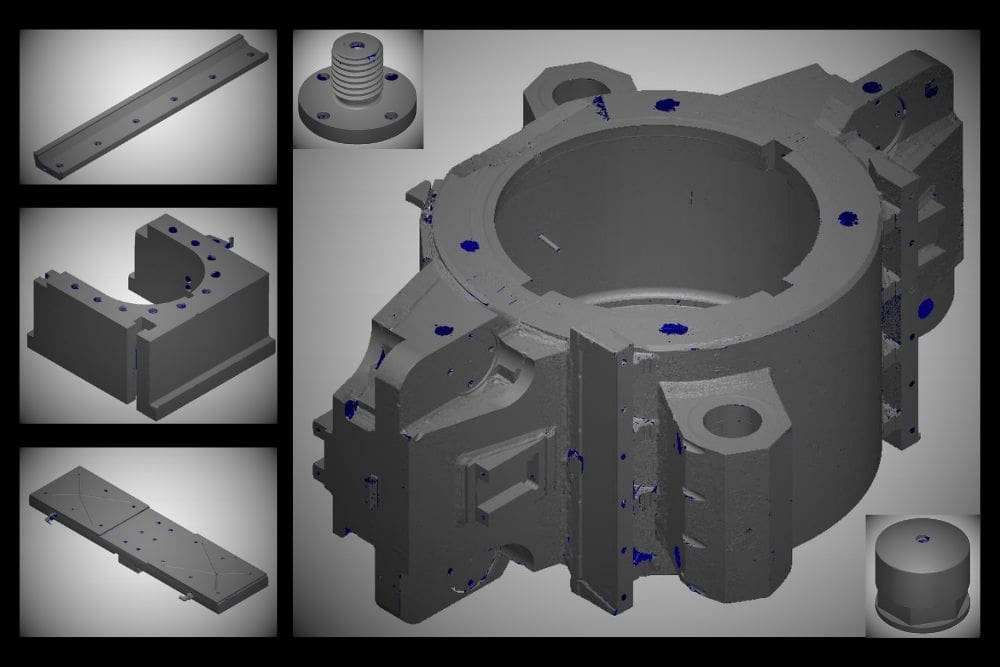
Among the components scanned were:
- Press container housing (1)
- Die bed and die bed cover (2, 3)
- Adjustment nuts (top and bottom) (4, 5)
- Adjustment screw (6)
- Slat and clamps No. 1, No. 2, No. 3, (7, 8, 9, 10)
- Rotating element between the adjustment screws (11)
- Guide slide (12)
The scanning process allowed us to collect detailed geometric information on each component.
This data was used to create models from “from nature” dimensions, as well as to prepare a full dimensional analysis, which is indispensable in the further stages of maintenance and production of replacements.
File Preparation and Data Analysis
A set of four final files has been prepared for each of the twelve elements:
- Polygon Model (.stl) – This model saved in .stl format allows visualization in three dimensions, which is necessary for further processing in CAD (Computer Aided Design)/CAM (Computer-Aided Manufacturing) post-programming.
- Component contour file (.igs) – Contains an accurate representation of the shape of a component, which will be used when third-party companies design new components.
- Polyworks file (.pwzip) – Allows you to open the project in Polyworks Reviewer and take simple additional measurements by the customer. Such a file allows the customer to quickly and easily verify the dimensions of individual components.
Additional Materials for the Customer
To make it easier for the customer to use the prepared materials, we also provided:
- An instructional video on how to use Polyworks Reviewer, which allows customers to create dimensions themselves on a scanned STL mesh. The video was a detailed guide so that anyone, even without prior knowledge of the software, could easily analyze the supplied files.
- The report in the form of a PDF file, which summarizes the work performed. It included detailed information on individual components, measurement results, and additional comments on component specifications.
- The exact dimensions of the container shown in three projections in line with the axes of the coordinate system, which allows full dimensional visualization of the component.
Technical Challenges and Measurement Accuracy
During the scanning process, we focused on the maximum accuracy of reproduction of the actual components. The dimensions obtained are “from nature” dimensions, which means that the diameters were given as average values (not maximum or minimum). For each element, a theoretical error in dimension acquisition of +/- 0.10 mm was assumed, which is in line with the project requirements given the wear of the scanned elements.
One of the interesting aspects of this project was to obtain edges by intersecting averaged elements, such as median planes. This means that the edges are not nominal (design) values, but have been determined on the worn existing elements, allowing the assessment of technical condition.
Modeling curvilinear edges
It is also worth mentioning that the curvilinear (free) edges were modeled using polylines – that is, a group of straight broken segments. This approach ensured sufficient accuracy while simplifying the model, which facilitates further processing and analysis.
 Summary
 Summary
The implementation of a project to scan and analyze twelve press components is an excellent example of the application of modern technology in the engineering industry. The prepared files provided the client with full geometric documentation, and additional materials, such as a report and instructional video, provided full support for further use of the data.
Thanks to the precise measurements and accurate analysis, the customer has gained a detailed understanding of the components of his machine and, most importantly, can now make decisions related to upgrading or replacing worn parts based on reliable data.
Contact us
Take advantage of our comprehensive scanning and analysis services for industrial components. We offer precise 3D scanning, creation of digital models in .stl, .igs .step formats, as well as detailed technical documentation in the form of PDF reports. Our services are ideal for maintenance, retrofitting and replacement manufacturing, guaranteeing full support and data reliability at every stage of the project. We look forward to working with you!